
Throughout 2022, China turned to the PLA as an increasingly capable instrument of Statecraft, strengthening its ability to 'fight and win wars' against a 'strong enemy', points out Ajai Shukla.

Finance Minister Nirmala Sitharaman will be presenting her fifth Budget that may do a tightrope walk between staying fiscally prudent and meeting general public expectations of lower taxes and a wider social security net, while at the same time firing the engines of the economy.

Inflation target remains 5% for January 2017.

The government may have to resort, eventually and however unwillingly, to printing money, abandoned as policy and practice in the 1990, predicts T N Ninan.

The agency had received Rs 946.51 crore to manage its affairs in the Budget Estimates for 2023-24, which was later increased to Rs 968.86 crore in the Revised Estimates.

Markets are assuming that by the second half of 2021, the world will be approaching some type of normalcy, points out Akash Prakash.

IMF's Chief Economist Gita Gopinath on Thursday said it would be damaging for India to start tightening policy support in the midst of the COVID-19 pandemic and also stressed on reducing wasteful expenditures in the upcoming Budget. Delivering NCAER's '9th C D Deshmukh Lecture' virtually, Gopinath said there is scope for the Indian government to provide more direct support to people.
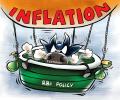
The Reserve Bank of India on Thursday marginally lowered its inflation projection for the current financial year to 5.1 per cent, as Governor Shaktikanta Das said the central bank's monetary policy actions are yielding the desired results. In April, the Reserve Bank had estimated the consumer price index (CPI) based retail inflation at 5.2 per cent during the fiscal 2023-24. CPI inflation fell sharply to 4.7 per cent in April 2023, from 6.4 per cent in February, on the back of favourable base effects, with softening observed across all the three major groups.

Reminiscent of the past two years, the market has made positive strides ahead of the Union Budget 2023-24 (FY24). The benchmark National Stock Exchange Nifty has gained 1.8 per cent in the last month. Typically, markets tend to gain ahead of the Budget as investors build in optimism.

'The cost of financing the fiscal deficit will decrease, as new passive investors join in.'

Several speakers noted that Budget carried the weight of expectations.
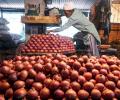
The government has banned exports of onion till March next year with a view to increase domestic availability and to keep prices in check. "Export policy of onions... is amended from free to prohibited till March 31, 2024," the Directorate General of Foreign Trade (DGFT) said in a notification. Local vendors in the national capital are selling onions at Rs 70-Rs 80 per kg.
.jpg)
The basis of Ind-Ra's expectation of INR appreciation is based on economic developments in the last one to two months of this fiscal and the likely developments in the remaining months.

This is the fourth consecutive time that the RBI has kept key interest rates unchanged despite clamours from the industry to cut rates to boost economy.
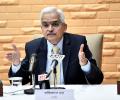
The Reserve Bank of India (RBI) on Wednesday raised the benchmark lending rate by 35 basis points to 6.25 per cent in a bid to tame inflation, which has remained above its tolerance level for the past 11 months. With the latest hike, the repo rate or the short-term lending rate at which banks borrow from the central bank now has crossed 6 per cent. This is the fifth consecutive rate hike after a 40 basis points increase in May and 50 basis points hike each in June, August and September.

The International Monetary Fund (IMF) has said the tightening of monetary policy by India is an 'appropriate' step, as the country is faced with high inflation and needs to consolidate the fiscal measures initiated during the slowdown.

Highlights of the RBI monetary policy.

Tactical investors should have an investment horizon of around six months to one year, long-term investors should stick around for 10 years or more.

The government on Monday hit out at bureaucracy for not keeping pace with policy changes and promised not to take recourse to borrowings
The Reserve Bank of India will release its review of economic developments in the fiscal year ended March 31, 2005 at 5:30 p.m. on Wednesday, an official spokesperson said.

'India's emergence as a top crypto market comes despite a regulatory and tax environment that can be challenging for the industry to navigate.'

The World Bank on Tuesday projected India's economy to grow at 8.3 per cent in 2021 and 7.5 per cent in 2022, even as its recovery is being hampered by an unprecedented second wave of the COVID-19, the largest outbreak in the world since the beginning of the deadly pandemic. The Washington-based global lender, in its latest issue of Global Economic Prospects released here, noted that in India, an enormous second COVID-19 wave is undermining the sharper-than-expected rebound in activity seen during the second half of Fiscal Year 2020/21, especially in services.

For current financial year, govt plans to borrow Rs 2.88 trillion in the first half of 2018-19, out of Rs 6.05 trillion planned for entire year

Amid expectations that the Reserve Bank may keep its monetary stance unchanged, the central bank will come out with its second quarter review of the credit policy for the current fiscal on October 27.

India's exports are expected to touch $360 billion in the current fiscal from $312.35 billion in 2013-14, Federation of Indian Export Organisations (FIEO) said.

RBI unsure whether to cut rates or not in its next monetary policy.

India will have to devise policies to ensure overall growth in FY16.
It took three years of collective fiscal profligacy and policy mismanagement to cause this crisis.

The agency has predicted that monsoon will also be a major factor.

India's economy is likely to grow by 12 per cent in 2021 following a 7.1 per cent contraction last year, as near-term prospects have turned more favourable, Moody's Analytics said. A stronger than expected December quarter GDP growth of 0.4 per cent following a 7.5 per cent contraction in the previous three months has turned India's near-term prospects more favourable, it said. Domestic and external demand has been on the mend since the easing of restrictions, which has led to improved manufacturing output in recent months.
With economic activity still to reach pre-pandemic levels, the RBI may slow down the pace of rate hikes until next year to quell soaring inflation while supporting growth, the Asian Development Bank (ADB) says in its latest report. The Manila-based multilateral funding agency has raised the inflation forecast for the current fiscal year ending in March 2023 to 6.7 per cent from its earlier projection of 5.8 per cent. For the next fiscal year too, the forecast has been revised upwards to 5.8 per cent from 5 per cent earlier.

The spike in food prices at the onset of the monsoon season has corroborated the Reserve Bank of India's (RBI's) view that the fight against inflation is far from over, the State of the Economy report of the central bank said. At the same time, the report said that the country is poised to become the fastest-growing major economy in the world, notwithstanding some sequential moderation in economic activity in June. Consumer Price Index (CPI)-based inflation rate increased to 4.8 per cent in June 2023, from 4.3 per cent in May, primarily on account of an increase in food inflation.
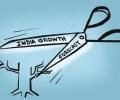
India's real GDP growth will decline marginally to 6.3 per cent in 2024 from the 6.4 per cent estimated for 2023, an American brokerage firm said on Monday. The next calendar year will be of two halves, wherein the government spending before the upcoming General Elections will be the key driver for growth, while after the elections, it will be the re-acceleration in investment growth, especially from the private sector, Goldman Sachs said in a report. From a fiscal year perspective, the brokerage said it expects growth to accelerate to 6.5 per cent for FY25 from the 6.2 per cent it has projected for the ongoing FY24, it added.

Bold reforms and prudent monetary and fiscal policies by the incoming Narendra Modi government will help the economy to grow at 6.5-7 percent, says a report.

Modi said that for nearly one and a half years he has been putting in place details of new schemes to give new pace to the country's development and curb poverty.
Rejecting arguments of "policy paralysis", Chidambaram said the economy is more stable than what it was two years.

India's economy is estimated to contract by 9.6 per cent in the fiscal year 2020-21, reflecting a sharp drop in household spending and private investment, and the growth is expected to recover to 5.4 per cent in 2021, the World Bank said on Tuesday. In its Global Economic Prospects report, the World Bank said that the informal sector, which accounts for four-fifths of employment, has been subject to severe income losses during the COVID-19 pandemic.

Foreign direct investment into the country is expected to rebound in the coming months on account of India's high economic growth, and steps to further improve the business environment of India, the Economic Survey said on Tuesday. The rise in global uncertainty in the wake of the Russia-Ukraine conflict, FDI equity inflows in the manufacturing sector in the first half of the current fiscal (April-September) fell below its corresponding level in the first half of 2021-22, the document, which was tabled in Parliament, said. The monetary tightening at the global level has further restricted the FDI equity inflows, the survey said.

'With China falling out of favour, India is where investors see the demographic and digital dividend apart from the benefits of reforms playing out.' 'Your prime minister has also done a great job of sharing this story with the world.'
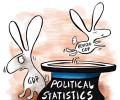
The SBI report, however, said the economic growth rate will pick up pace in 2020-21 to 6.2 per cent.
